

Uncategorized
Replica Watch Factory Explained: How Different Factories Build Patek Philippe Replicas
Why Different Factories Make the Same Patek Philippe Models
Anyone researching Patek Philippe replicas will quickly notice that the same reference may be offered by Different Factories. A Nautilus 5711, Aquanaut 5167, or Calatrava-style replica can appear in several versions, even when the watches look almost identical in basic product photos. The reason is that replica production is not controlled by one centralized manufacturer. Different producers develop their own versions according to cost, available movements, case suppliers, dial makers, and finishing standards. Some focus heavily on external appearance, while others put more effort into movement decoration or case proportions. This is why two watches based on the same genuine reference can feel noticeably different in person. The factory name can offer some clues, but the actual construction, batch, movement, and finishing quality usually tell a more complete story.
A Factory Is Often a Network, Not One Workshop
The term “factory” can create the wrong picture. In traditional Swiss watchmaking, a manufacture may design, produce, assemble, and finish many components under one company structure. Replica production often works differently. A so-called factory may coordinate several specialized suppliers rather than manufacture every component itself. One supplier may produce the stainless-steel case, another may make the dial, while separate workshops handle bracelets, crystals, hands, or movement decoration. Final assembly and quality control may happen elsewhere. This supplier-based structure helps explain why Different Factories can produce watches that share certain components but still differ in overall execution. It also explains why production quality may change between batches. If one supplier changes its material, machining process, or finishing standard, the next version of the same watch can look or feel different even when the factory name remains unchanged.
Case Shape Reveals More Than Front Photos
Patek Philippe sports watches are especially sensitive to case proportions. The Nautilus may look simple at first glance, but the relationship between the bezel, mid-case, side profile, crown, and bracelet integration is difficult to reproduce consistently. A small change in thickness can alter the entire character of the watch. Some factories may prioritize a thinner profile, while others accept additional thickness because of the movement they use. The quality of brushing and polishing also matters. Genuine luxury watches are known for sharp but controlled transitions between brushed surfaces and polished edges. On replicas, these transitions can be softer, wider, or less consistent. Comparing Different Factories therefore requires more than looking at a straight-on dial photo. Side-profile images, bezel shape, lug geometry, crown position, and case finishing can reveal differences that are almost invisible when the watch is photographed only from the front.
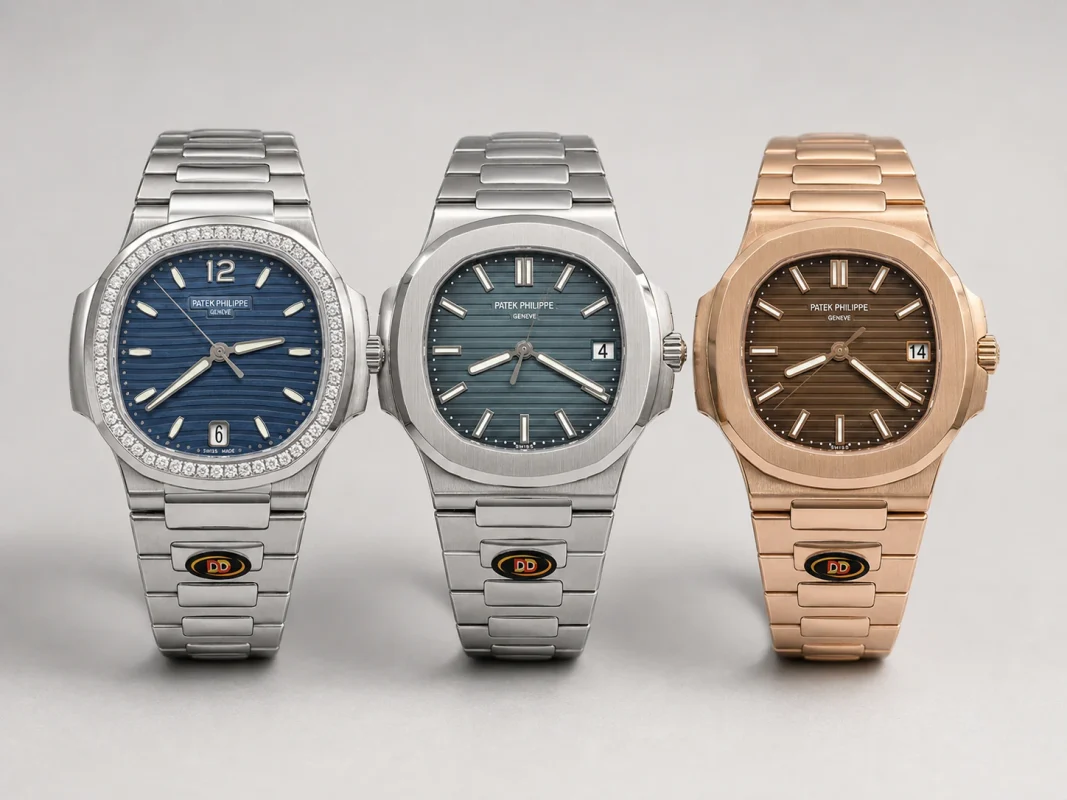
Dial Work Can Change the Entire Impression
The dial is often where a Patek Philippe replica either looks convincing or immediately feels slightly wrong. Nautilus models are particularly challenging because the horizontal dial texture, color gradient, metallic finish, indexes, printing, and date window all contribute to the final appearance. Two factories may use similar case construction while choosing completely different dial suppliers. One version may have more accurate proportions but a flat-looking dial, while another may create a stronger sunburst effect but use less precise printing. Index alignment and hand finishing also matter because small inconsistencies become obvious on a relatively clean Patek Philippe design. Lighting makes comparison even more complicated. A dial that looks dark blue in studio photography may appear grey, green, or much brighter outdoors. For that reason, evaluating dial quality usually requires several photos taken under different lighting conditions instead of relying on one carefully edited product image.
Movement Choice Shapes the Whole Watch
Movement selection affects far more than what can be seen through the caseback. A generic automatic movement may be reliable and easier to service, but its dimensions can force the manufacturer to change case thickness, crown position, or internal construction. Other versions may use modified movements with decorative bridges, engraved rotors, or components designed to visually resemble the architecture of the original Patek Philippe caliber. More ambitious projects may attempt to copy the visible layout more closely, although visual similarity does not mean the engineering, materials, performance, or long-term reliability are equivalent to the genuine movement. This is one reason Different Factories can take very different approaches to the same reference. A factory focused on appearance may accept a less accurate movement, while another may spend more development cost on movement presentation. That choice can influence both the price and the physical dimensions of the finished watch.
Bracelet Quality Is Easy to Miss Online
The bracelet deserves much more attention than it usually receives in replica comparisons. On a Nautilus, the bracelet is not simply an accessory attached to the case; it is a major part of the watch’s design and wearing experience. Link shape, articulation, brushing, polished sections, edge finishing, clasp construction, and tolerances can all affect how refined the watch feels on the wrist. Lower-cost versions may look acceptable in photographs but feel stiff when handled. Better-finished bracelets normally move more naturally and show cleaner transitions between surfaces. Gaps between links can also reveal differences in machining precision. The clasp is another useful comparison point because engraving depth, closing action, and internal finishing may vary considerably between versions. Buyers who compare only dial photos often overlook these details, yet bracelet construction is one of the areas where differences in manufacturing standards become particularly noticeable during everyday handling.
Price Usually Reflects a Set of Compromises
A more expensive version is not automatically superior in every category. Replica production involves constant compromises between appearance, movement choice, machining cost, finishing time, supplier quality, and production volume. One factory may invest heavily in an improved dial but reuse an older bracelet design. Another may introduce a more elaborate movement while keeping the same case tooling. A third may focus on overall consistency rather than maximizing one specific feature. This is why comparing Different Factories purely by price can be misleading. The more useful question is what has actually been improved in a particular version. Case thickness, bezel geometry, dial texture, movement layout, bracelet articulation, crystal profile, and date-window construction should all be considered separately. Factory reputation can provide context, but model-specific execution matters more because a manufacturer that performs well on one reference may not necessarily produce the strongest version of another.
Factory Names Matter Less Than the Version
Factory names are useful shorthand, but they should not be treated as permanent quality guarantees. Replica production can change quickly as suppliers, movements, tooling, and batches are updated. A well-known factory name may also be used differently by resellers, making direct comparisons harder than they first appear. For that reason, a Patek Philippe replica is better evaluated as a specific version rather than simply as a product from a particular factory. Check the reference, generation, movement type, case dimensions, dial characteristics, bracelet construction, and actual photos of the current batch. When comparing Different Factories, these details provide more practical information than reputation alone. The factory tells part of the story, but the finished watch tells the rest. For readers trying to understand why two replicas of the same Patek Philippe model can differ so much, examining the construction choices behind each version is the most useful place to start.
